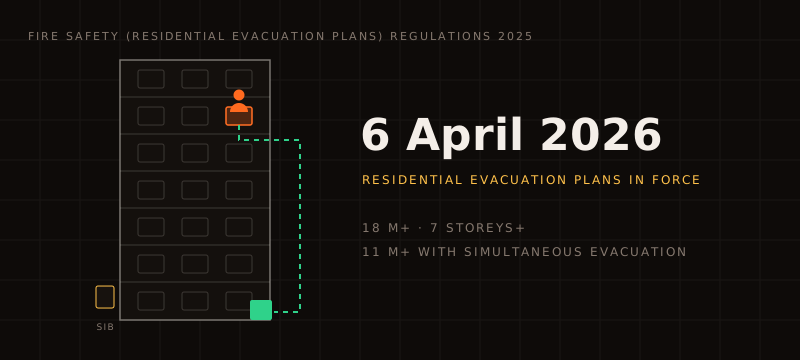
Since 6 April 2026, responsible persons for many tall residential buildings in England have had to offer residents who would struggle to get out in a fire a person-centred assessment and an evacuation plan.
The rules come from the Fire Safety (Residential Evacuation Plans) (England) Regulations 2025, made on 3 July 2025. If you own or manage flats, here is who they cover and what you have to do.
Which buildings are covered?
A building with two or more sets of flats or other domestic premises that is any one of:
- At least 18 metres high
- At least seven storeys
- More than 11 metres high with a simultaneous evacuation strategy, where everyone is told to leave as soon as there is a fire
Your fire risk assessment should already state the building’s evacuation strategy. If you aren’t sure whether it is “stay put” or simultaneous evacuation, that is the first thing to check.
Which residents are covered?
“Relevant residents” are people whose main home is in the building and whose ability to evacuate without help is compromised by a cognitive or physical impairment or condition. That can include people with mobility problems, sight or hearing loss, dementia, or a temporary condition.
What the responsible person must do
- Identify. Make reasonable efforts to find out which residents are relevant residents.
- Offer an assessment. Offer each of them a person-centred fire risk assessment, and carry one out for anyone who accepts.
- Reduce the risks. After talking it through with the resident, put reasonable and proportionate measures in place.
- Agree an evacuation statement. Make reasonable efforts to agree how the resident will get out, record it as an “emergency evacuation statement” and give them a copy.
- Share information with the fire service. With the resident’s explicit consent, give the local fire and rescue service their flat and floor number and the help they would need, either electronically or in a secure information box.
- Prepare a building evacuation plan. Set out the evacuation arrangements for the building and give a copy to the fire and rescue service.
Reviews, costs and consent
- Reviews. Each resident’s assessment and evacuation statement must be reviewed at least every 12 months, and sooner if things change or the resident asks. The building evacuation plan is also reviewed every 12 months.
- Costs. The responsible person can pay for measures or share the cost among residents, but only where the measure benefits most residents. Anything the resident is asked to pay for needs their payment before it goes in.
- Data protection. This is personal health information. Handle it under data protection law and only share it with the fire service with explicit consent.
What to do now
- Confirm the building’s height, storeys and evacuation strategy from your fire risk assessment
- Write to every household asking whether anyone would need help to evacuate
- Offer person-centred fire risk assessments and record who accepted or declined
- Agree and record emergency evacuation statements, and give residents their copies
- Check with the fire and rescue service how they want the information, and install a secure information box if needed
- Prepare the building evacuation plan and diarise the 12-month reviews
These rules sit alongside your other duties for flats. See fire safety in flats and HMOs for the full picture.
Need help with PEEPs?
Steve prepares personal and general emergency evacuation plans, and confirms your building’s evacuation strategy as part of a fire risk assessment.