If you let a cottage, flat or lodge to paying guests, the Fire Safety Order applies to you, and since 1 October 2023 your fire risk assessment must be written down in full.
Does the law apply to my holiday let?
Yes. Self-catering holiday properties are covered by the Regulatory Reform (Fire Safety) Order 2005, whether you let one cottage or several. The owner, or the agent who controls the property, is the responsible person.
Since 1 October 2023, every responsible person must record the full fire risk assessment, not just the significant findings, along with who carried it out. You must also act on what it finds, and review it at least once a year or after changes such as adding a bedroom.
The government guide for small holiday lets
The government’s guide to making small paying guest accommodation safe from fire covers properties such as houses, cottages and chalets on the ground floor, or ground and first floor, sleeping up to 10 people with no more than four bedrooms on the first floor. It also covers individual flats. Larger or more complex properties follow the fuller sleeping accommodation guidance.
What a typical small holiday let needs
Smoke and heat alarms
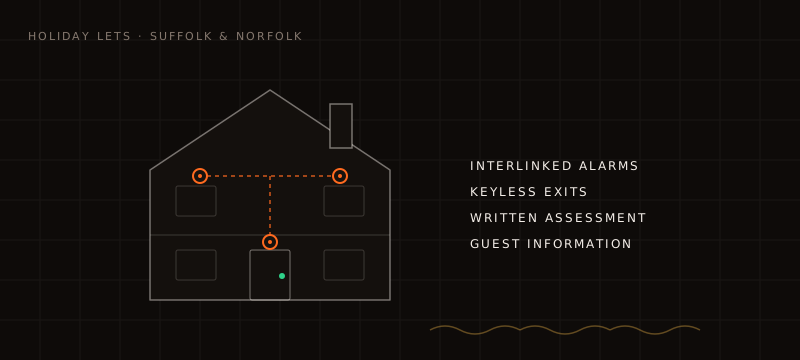
Interlinked smoke alarms in the hall, landing and stairs, living areas and bedrooms, with a heat alarm in the kitchen. Mains-wired alarms with battery backup are the expected standard; sealed 10-year battery alarms may be acceptable in very small properties. Test them and log the result.
Escape routes
Routes kept clear, and exit doors that open without a key, such as thumb-turn locks. Guests should not have to rely on windows to escape.
Lighting
Consider whether street lighting is enough at night. If not, small properties may use automatic rechargeable torches with clear signs; larger ones need emergency lighting.
Firefighting equipment
Typically a fire blanket in the kitchen and a multi-purpose extinguisher on each floor near the stairs, with clear instructions that guests should only tackle very small fires.
Information for guests
What the alarm sounds like, what to do in a fire, how to call 999 with the property’s address, and any rules on candles, barbecues and smoking.
Holiday let fire safety checklist
- Fire risk assessment recorded in full, with the assessor’s name
- Review date set: at least yearly, and after any change to the property
- Interlinked smoke alarms and kitchen heat alarm tested at every changeover
- Escape routes clear, exit doors open without a key
- Fire blanket and extinguishers in date and serviced
- Emergency lighting or rechargeable torches working
- Guest fire information displayed, including the full address for 999 calls
- Candle, barbecue and smoking rules in the guest information
- A log of every test, service and changeover check
Inspections and enforcement
Fire and rescue services inspect holiday properties. Owners who don’t comply can face enforcement action, prosecution, fines or imprisonment.
Holiday let assessments on the coast and inland
Steve assesses holiday lets across Suffolk and Norfolk, with a written report you can keep in the property and free follow-up advice.