The law sets no expiry date for a fire risk assessment. Here’s what it does require, which changes should trigger a review and how to record it.
Once you have a fire risk assessment, how long is it good for? The answer isn’t a date printed on the front of the report. The law expects you to keep the assessment up to date, which means looking at it again regularly and whenever something changes.
What the law says
Under article 9 of the Regulatory Reform (Fire Safety) Order 2005, the responsible person must review the assessment “regularly so as to keep it up to date”, and particularly if there is reason to suspect it is no longer valid, or there has been a significant change in the matters it relates to. If the review shows that changes are needed, you must make them.
The Order doesn’t set a fixed interval, and neither does the government’s guidance. The gov.uk guidance on workplace fire safety simply says the responsible person must carry out and regularly review a fire risk assessment of the premises. In a workplace, the responsible person is the employer, if the workplace is to any extent under their control.
So how often in practice?
Because the law says “regularly” rather than giving a number, you need a sensible routine. My advice is to sit down with the assessment at least once a year, even if nothing seems to have changed, and to put the next review date in the diary when you finish. Premises where people sleep, where vulnerable people are present or where higher-risk work goes on deserve a closer eye.
A useful review starts with a few questions:
- Has anything changed in the building, its layout or how it’s used?
- Are more people, or different people, using it, including anyone who would need help to get out?
- Have the actions in the last report been completed, starting with the highest priority items?
- Are the fire alarm, emergency lighting and extinguishers being tested and serviced, with records to show it?
- Have staff had their fire safety training?
- Have there been any fires, false alarms or near misses?
A review isn’t the same as starting again. The government’s fire safety guide for offices and shops says not to amend the assessment for every trivial change, but to consider any new hazards a change brings in. If the building or the way you use it has changed a lot, a fresh assessment is often the better option.
Changes that should trigger a review
Don’t wait for the yearly date if something significant changes. The same government guide lists reasons for a review, which could include:
- changes to how you work or organise the work, including new equipment
- alterations to the building, including the internal layout
- substantial changes to furniture and fixings
- starting to store hazardous substances, changing them or storing more
- a failure of fire precautions, such as the fire detection and alarm system
- significant changes to displays or quantities of stock
- a significant increase in the number of people present
- people with a disability using the premises
A fire or a near miss belongs on that list too. The guide says it could indicate that your existing assessment may be inadequate, so look at what happened and why.
If you’re responsible for a block of flats or a building split into flats, check when the assessment was last done. The Fire Safety Act 2021, in force since 16 May 2022, makes clear that the assessment for a building with two or more sets of domestic premises must take account of the structure, external walls and flat entrance doors. An assessment done before then may not cover them. There’s more in my guide to fire safety in flats and HMOs.
Writing the review down
Since 1 October 2023, every responsible person must record the fire risk assessment in full, along with their fire safety arrangements, under changes made by section 156 of the Building Safety Act 2022. Article 9 also requires a record of each review, made as soon as practicable after it is done.
The government’s five-step fire risk assessment checklist says you must keep a record that you have reviewed the assessment and the date you did so. Where little has changed it can be short, but it should show who did the review, when, what was found, what has been or will be done, and anyone identified as especially at risk.
If you engage someone to carry out or review the assessment for you, record their name and, where it applies, their organisation. And if responsibility for the premises passes to someone else, the fire risk assessment and review records are part of the fire safety information you must hand over.
Who can carry out the review
As the responsible person, you can review the assessment yourself. For small, simple premises, the government’s guide for small non-domestic premises says an assessment can often be done without specialist knowledge, but if you don’t feel able to do it, you should engage a competent fire risk assessor. The same thinking applies to a review: the larger or more complex the building, the more sense it makes to bring someone in. If you do, it’s worth knowing what makes a fire safety assessor competent.
How I can help
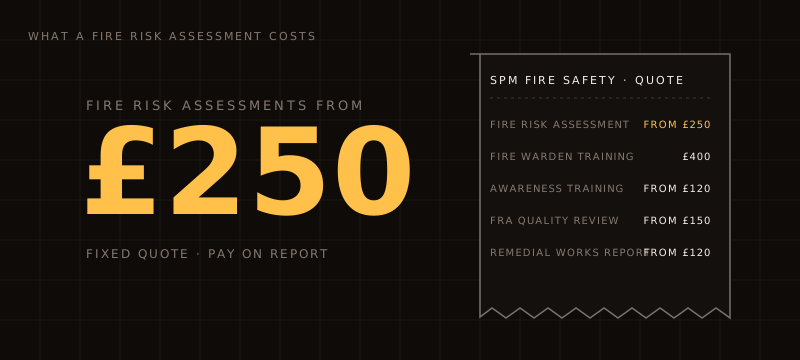
If your assessment is due a review, or you’re not sure it still reflects your premises, I can help. I carry out fire risk assessments across Suffolk, Norfolk, Cambridgeshire and North Essex from £250, with a fixed quote and nothing to pay until your report is ready. If someone else wrote your current report, I also offer a £75 online desktop review. See my services and prices, send me a message or call me on 07905 199 521.
Not sure your assessment is still valid?
Send me an existing report written by someone else and I’ll review it online for £75.
Keep reading